
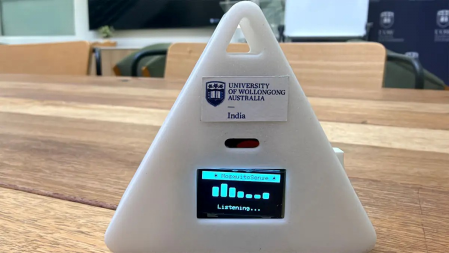
Associate Professor Kiran Trivedi from the University of Wollongong (UOW) India has developed a low-cost artificial intelligence (AI)-powered device that can identify disease-carrying mosquito species within seconds by analysing the sound of their wingbeats.
The portable device uses Tiny Machine Learning (TinyML) to detect three major mosquito species—Aedes, Anopheles and Culex—which are responsible for spreading diseases such as dengue, malaria and chikungunya. The system works without internet connectivity or cloud computing, allowing it to identify mosquito species in real time in remote or resource-limited areas.
According to the university, the device was developed in collaboration with Trivedi’s former student Harsh Shroff. It is built on an Arduino-based platform with an integrated microphone and display. The AI model, trained using publicly available mosquito sound recordings, achieved an accuracy of 88.3% in identifying mosquito species.
Unlike conventional mosquito surveillance methods that require collecting larvae and laboratory analysis, the new device identifies mosquitoes through the unique acoustic signatures produced by their wingbeats. This enables faster, on-site monitoring and could support early detection of disease vectors.
The innovation was recently showcased at the United Nations AI for Good Global Summit in Geneva, where Trivedi demonstrated how low-cost edge AI technologies can be used to address public health challenges.
Trivedi said the technology has the potential to be deployed in surveillance networks that continuously monitor mosquito populations and provide real-time data on emerging disease hotspots. He added that such systems could help public health agencies improve outbreak preparedness and strengthen disease surveillance, particularly in areas with limited laboratory infrastructure.