
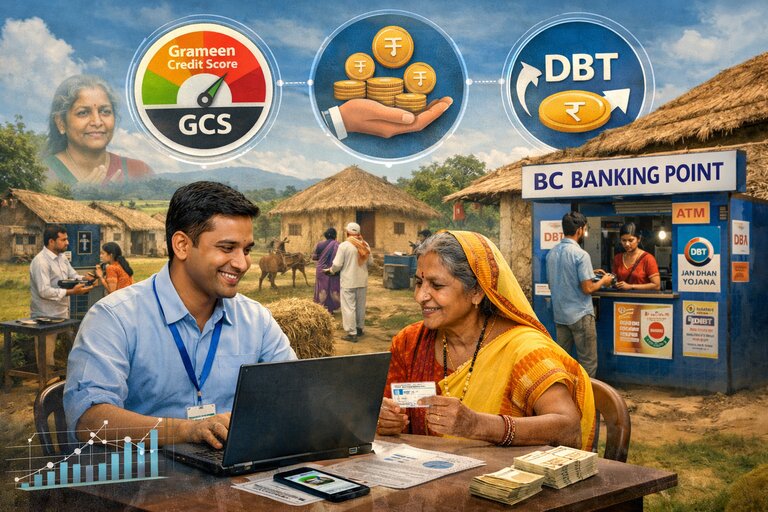
The government has asked banks to adopt the Grameen Credit Score (GCS) framework to assess rural borrowers, signalling a shift towards alternative data-led lending for underserved segments.
The move aims to expand formal credit access for millions in rural and semi-urban areas who remain outside traditional credit bureaus due to the absence of formal financial histories.
The directive comes as India’s financial inclusion drive has scaled significantly. According to Finance Minister Nirmala Sitharaman, over 50 crore Jan Dhan accounts have been opened, with deposits exceeding ₹2 lakh crore, creating one of the world’s largest banking inclusion ecosystems.
However, despite wider access to banking, a gap persists in credit penetration, with many account holders still excluded from formal lending.
Lokanath Panda, COO, BLS E-Services Limited, said the success of the GCS framework will depend on the strength of last-mile data infrastructure.
“Business Correspondent (BC) networks, which act as an extension of banks in rural areas, are emerging as a critical link. These networks facilitate frequent financial transactions, including account operations, cash handling and Direct Benefit Transfer (DBT) disbursements, generating granular financial data for assessing borrower behaviour,” he said.
India’s BC ecosystem spans thousands of rural touchpoints. BLS E-Services alone operates over 45,000 BC outlets, with around 80% located in tier-4 and tier-5 regions.
Panda added that while the GCS framework is a step towards improving credit access, its effectiveness will depend on leveraging real-time, on-ground financial data.
“BC networks are already capturing transaction-level behaviour—from DBT inflows to savings patterns—which can help lenders assess first-time borrowers lacking formal credit histories,” he said.
Unlike urban borrowers with established bureau scores, rural customers often operate within informal financial systems, limiting their access to institutional credit.
The GCS framework seeks to address this by incorporating alternative data into credit assessment. However, challenges may remain without robust last-mile data capture and validation.
The development reflects a broader shift in India’s financial inclusion journey—from account ownership to credit enablement. As banks align with the directive, partnerships with BC networks are expected to deepen, positioning them as a key layer in rural credit delivery.