
Industry experts highlight capital expenditure, shared MSME credit systems and advanced manufacturing support.
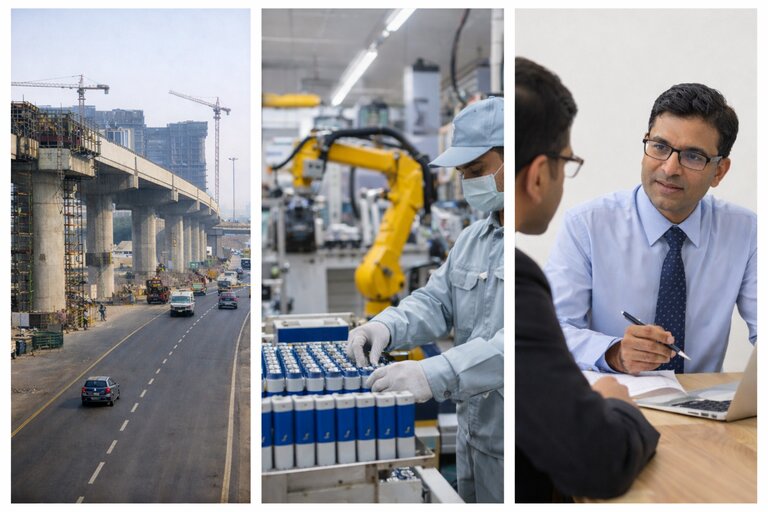
Industry leaders react to Union Budget 2026–27 on infrastructure capex, MSME credit reforms, manufacturing, and EV sector support.
Industry representatives from infrastructure, finance, manufacturing, and consumer-facing sectors responded to the Union Budget 2026–27, highlighting measures to boost capital expenditure, improve MSME credit efficiency, and strengthen domestic manufacturing and EV-related industries.
The Budget proposed public capital expenditure of ₹12.2 lakh crore, expanded support for MSME financing, and initiatives to promote advanced manufacturing and electronics.
Infrastructure Response
Infrastructure expert and urban planner Dikshu C. Kukreja said the sustained increase in public capital expenditure signals the government’s long-term commitment to infrastructure-led growth.
“The jump in public capital expenditure from ₹2 lakh crore in 2014–15 to ₹11.2 lakh crore in Budget 2025–26, with a proposed increase to ₹12.2 lakh crore in FY 2026–27, reflects the government’s long-term commitment to infrastructure-led growth. This scale of investment will significantly reduce logistics costs, bring in private capital, and accelerate the economic development of urban precincts across India,” he said.
He added that the Infrastructure Risk Guarantee Fund, along with tools like REITs and InvITs, could reduce construction-phase risks and attract private participation in roads, urban infrastructure, and real estate-linked assets.
Image suggestion: Place your combined image here, as it visually covers infrastructure, manufacturing, and finance.
MSME Credit Reforms
On MSME financing, Sorabh Dhawan, CEO of PSB Xchange, said:
“MSME credit cannot scale through fragmented, bank-by-bank models. What’s required is shared infrastructure that reduces friction while preserving credit discipline. PSB Xchange is designed to enable exactly this kind of system-level efficiency for public sector banking.”
Raja Debnath, MD of Veefin, added:
“Budget 2026 recognises that MSME growth will be constrained less by intent and more by the efficiency of credit delivery. Working capital must move with transactions, not balance sheets. The real unlock lies in building systems that allow capital to flow at speed, with discipline, and at scale.”
Manufacturing and EV Sector Support
Ravi Mehra, Managing Director of Uno Minda, welcomed measures for advanced manufacturing and domestic EV battery production:
“We welcome the Union Budget 2026–27, which is focused on strengthening India’s manufacturing ecosystem, advancing Viksit Bharat, and fostering Aatmanirbharta, driven by initiatives to boost MSME growth and reduce import dependencies.
The strong push for electronics and advanced manufacturing, including the ₹40,000-crore Electronics Components Manufacturing Scheme and India Semiconductor Mission 2.0, will strengthen domestic value chains and support the auto components sector.
The addition of 35 capital goods for EV batteries to the list of exempted items will boost domestic production, reduce import dependence, and support electric mobility and energy storage in India.”
Consumer and Industry Sectors
Consumer-facing sectors highlighted the importance of fiscal stability. Chetan Thadeshwar, Chairman & MD of Shringar House of Mangalsutra, said disciplined fiscal management and predictable policy measures could strengthen household confidence and discretionary demand, especially in the jewellery sector.
J.K. Arora, Chairman & MD of SOM Distilleries & Breweries Ltd, noted that the alco-beverage manufacturing sector continues to face structural cost pressures due to the absence of GST input credit on key raw materials and services, which impacts competitiveness.ace structural cost pressures due to the absence of GST input credit on key raw materials and services, which impacts competitiveness.